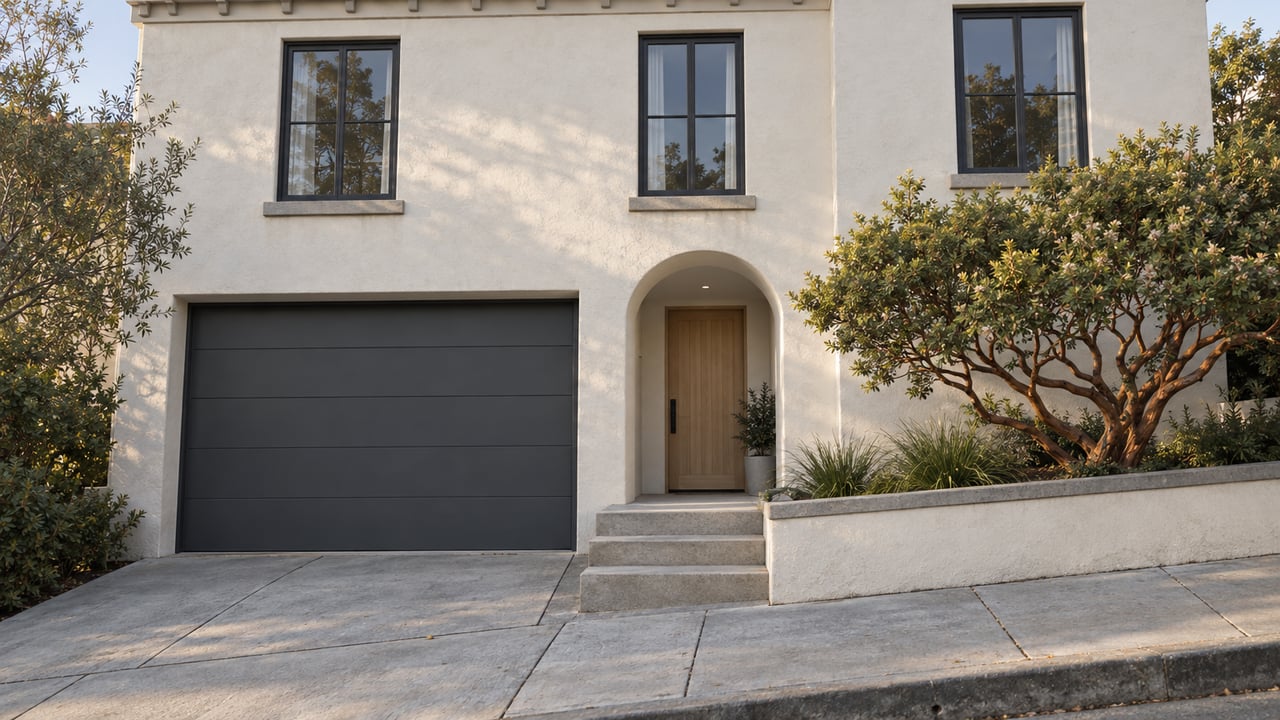
San Bruno's Flight-Path Discount Is About to Meet Its Biggest Test
Drive up Sneath Lane from El Camino Real and the topography does the explaining for you. To the west, the road climbs into the hillside neighborhoods of Crestmoor and Rollingwood, where the houses sit above the fog line and the jets on approach to SFO pass overhead as a distant hum. To the east, the road flattens out toward Huntington Avenue, the BART tracks, and the parking lot of the old Tanforan Mall, where the same jets are close enough to interrupt a phone call. San Bruno has always priced these two halves of itself differently. What changes this year is that both halves are about to get major new construction at the same time, for entirely different reasons, and neither side has done this before under the terms now in play.
The mechanism behind San Bruno's split pricing isn't a mystery. Homes closest to SFO's flight corridor sell at a documented discount compared to otherwise similar homes in quieter parts of San Mateo County, and San Bruno sits among the most affected cities because of how close its eastern neighborhoods sit to the airport's approach paths. That discount typically runs 5 to 15 percent, which on a $1.5 million home works out to $75,000 to $225,000 in savings.
What makes this a genuine market mechanism rather than a temporary dip is that the discount doesn't close over time. Flight-path homes in San Mateo County have historically appreciated at roughly the same rate as their quieter counterparts in the same city, which means the buyer who takes the discount today is also the seller who passes it along later. You aren't betting that the noise goes away. You're pricing in that it doesn't.
Modern windows help more than most buyers expect. Dual-pane glass, standard in Bay Area construction since the 1990s, cuts interior noise by 25 to 30 decibels, and older homes can retrofit their way most of the way there with sound-rated replacements. That's a renovation decision, not a market one. It changes how a house lives day to day. It doesn't erase the line on the map that separates San Bruno's two pricing tiers.
On the hillside side of that line sit Crestmoor, Rollingwood, and Portola Highlands, along with the view-tier pockets of Pacific Heights above Interstate 280. On the flats side sit Belle Air, San Bruno Park, and the Mills Park area that wraps around the BART station and the old mall. Buyers touring both in the same weekend aren't touring one market. They're touring two, and the price gap between them is doing exactly what it's supposed to do.
For most of San Bruno's history, that premium hillside tier stayed premium partly because there was nowhere left to build there. That changed with the sale of the old Crestmoor High School site.
The 40-acre property at 300 Piedmont Avenue, vacant since the school closed decades ago, was sold by the San Mateo Union High School District to SummerHill Homes for $86,552,000, a deal finalized after nearly a decade of negotiation. Demolition of the former school buildings is underway to make way for 155 new single-family homes. It's the first significant infusion of new construction the hillside tier has seen in a generation, and it's arriving on the quiet, view-facing side of San Bruno's divide rather than the discounted flats.
That matters for anyone assuming the premium tier is a fixed, unchanging supply of older ranch houses. It isn't anymore. A buyer weighing a resale Crestmoor home against a new-build option a few blocks away is about to have that choice for the first time in years.
The other side of San Bruno's divide is getting its own construction story, and it's the one with the longer runway and the bigger numbers.
The Shops at Tanforan, the 44-acre mall site bounded by El Camino Real, Huntington Avenue, Sneath Lane, and Interstate 380, sits almost entirely inside the discounted flight-path tier and directly adjacent to the San Bruno BART station. Developer Alexandria Real Estate Equities, working with Strada Investment Group, has proposed replacing most of the existing mall with a transit-oriented mixed-use district. According to the city's own environmental review, the current plan calls for roughly 1,000 multi-family residential units, including up to 200 designated as affordable housing, alongside about 711,000 square feet of life-science and office space and roughly 250,000 square feet of retail.
Target and the Century at Tanforan Theater are expected to keep operating throughout construction, a detail the city has emphasized to reassure longtime shoppers that the site won't simply go dark for years. The Tanforan Memorial, which honors Japanese Americans detained at the site before being sent to internment camps during World War II, will also remain as part of the redevelopment.
Peter Gilli, the city's community development director, has called the project a "once-in-a-generation opportunity" for a site that's been in decline since online shopping and the pandemic hollowed out its retail base. That opportunity is now close to a formal decision. The project's own public timeline lists Fall 2026 for Planning Commission and City Council consideration of final zoning, the subdivision map, the environmental impact report, and the development agreement, with demolition and site preparation targeted for 2027 and the first phases of new construction beginning in 2028 or 2029. The full build-out, spanning housing, retail, and life-science space across the entire 44 acres, is expected to take years beyond that.
The Tanforan vote isn't the only structural change converging on San Bruno's discounted side this year. California's SB79 took effect on July 1, 2026, allowing greater building height and density for housing projects within a half mile of rail transit stations, a category that includes both the San Bruno BART station and the San Bruno Caltrain station. A joint study session held by the city's Planning Commission and City Council in May 2026 took up SB79 alongside the Tanforan update and a broader initiative on citywide land use called Elevate San Bruno, along with a look at zoning changes for the downtown corridor.
The half-mile radius from San Bruno BART reaches into Mills Park and much of the Belle Air flats, the same neighborhoods carrying the flight-path discount. That overlap means the parcels most likely to see new height and density under state law are largely the same parcels that have historically traded at a discount because of airport noise. Two separate policy tracks, a state housing law and a single large redevelopment project, are pointed at the same stretch of the city in the same year.
For a buyer eyeing the hillside tier, the arithmetic hasn't changed as much as the inventory has. Crestmoor, Rollingwood, and the surrounding view neighborhoods still carry their premium, but the 155 homes rising on the old high school site give buyers a new-construction option in a submarket that hasn't had one in years. That's worth touring even for buyers who assumed resale was the only choice up there.
For a buyer eyeing the flats, the calculus is more layered. The flight-path discount has been reliable for years because it reflected a real, persistent condition. What's less certain is how that discount holds up once the area around it stops looking like a declining strip mall and starts looking like a life-science and transit hub with a few thousand new residents. Nothing in the current plans changes the flight paths overhead. What changes is everything built underneath them.
For a seller on either side, the practical takeaway is the same. A citywide median price was never going to describe either of San Bruno's two markets accurately, and it's going to describe them even less accurately once construction starts changing what each side actually contains. Pricing a listing well this year means pricing it against its actual submarket, not against a blended number that was already smoothing over the difference between a hillside ranch house and a flats condo half a mile from a jet's final approach.
Will the Tanforan redevelopment or SB79 eliminate San Bruno's flight-path discount? Nothing in either plan changes SFO's flight paths or noise levels. The discount has historically tracked noise exposure, not the age or condition of nearby buildings, so a newer, denser Tanforan district built under the same flight corridor would be expected to carry a similar relative discount to what the existing homes there carry now.
When will the Tanforan project actually be decided? The project's public timeline points to Fall 2026 for the Planning Commission and City Council to consider final adoption of the zoning, subdivision map, environmental impact report, and development agreement, with demolition targeted for 2027 and the first phase of new construction expected in 2028 or 2029.
Does SB79 apply to the whole city or just parts of it? It applies within a half mile of qualifying rail transit stations, which in San Bruno means the area around the BART and Caltrain stations rather than the entire city. That radius overlaps significantly with the flats neighborhoods nearest Tanforan.
If you're trying to figure out where your own home, or the home you're considering, falls on either side of this divide, Wang Tang Group can walk through the specifics with you. Request a free home valuation and we'll tell you plainly what your address is actually worth in the market it's really in.
Jenny and Carmen live with their families in the Peninsula and are trusted by hundreds of clients, having successfully closed countless transactions across San Mateo, San Francisco, Santa Clara, and Alameda counties. From property upgrades, inspections, and strategic marketing to finding the best lenders, they guide clients through every step of the real estate journey.

Wang Tang Group
Address
1440 CHAPIN AVE STE 200
BURLINGAME, CA 94010
Jenny Wang | CA DRE# 02063767
Carmen Tang | CA DRE# 01974969