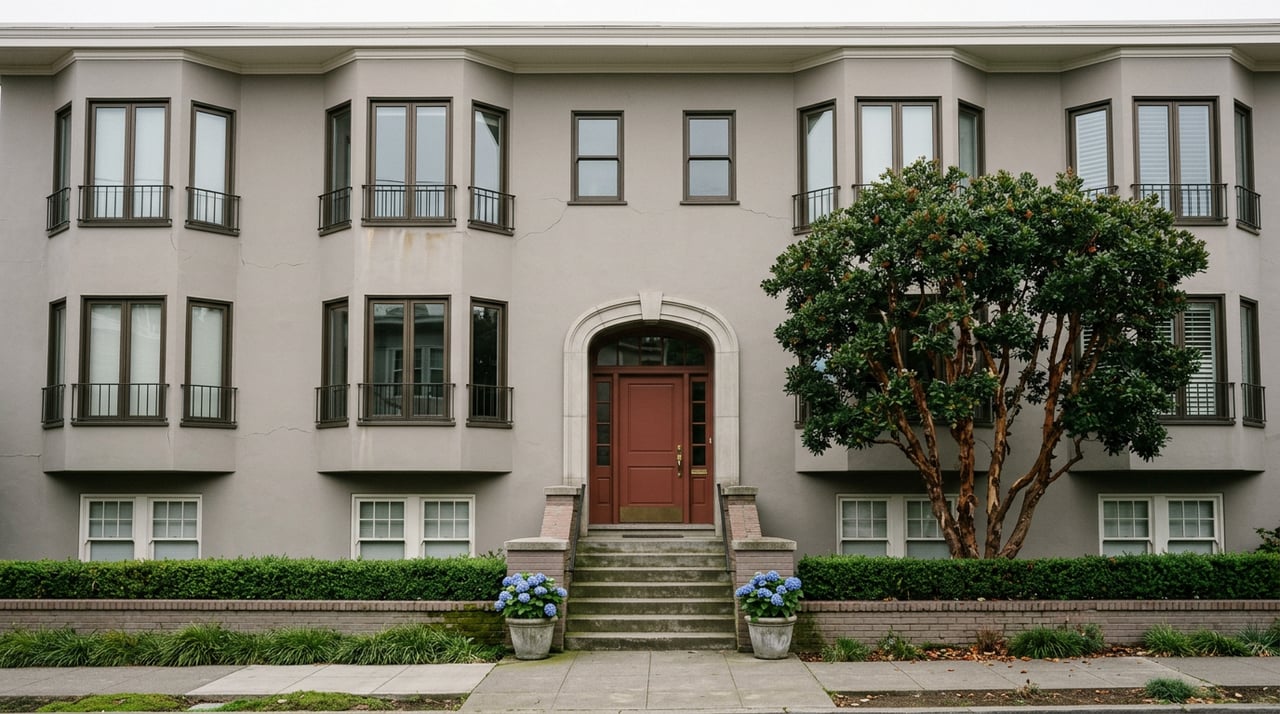
San Francisco's Condo Rebound Is Real. So Is the Building That Can't Get a Loan.
Two San Francisco condos can sit three blocks apart, list at a similar price per square foot, and end up living in completely different mortgage markets this year. One closes in three weeks with a conventional loan and multiple offers. The other sits, because the lender pulled the building's file and found a problem that has nothing to do with the unit itself.
That split is the real story behind a headline number making the rounds this fall: San Francisco condo prices are up sharply, with the median condo sale price reaching $1.233 million in August 2026, a 22.3% jump from a year earlier, according to a September 2026 market report from Prism Group. After years of condos underperforming houses in this city, that looks like a comeback. It is not the comeback it appears to be. It is a sorting mechanism, and understanding how it sorts buildings is the difference between buying into a condo that appreciates and one that becomes hard to sell through no fault of the unit or the owner.
Start with a real example. The Mira, the 39-story tower at 280 Spear Street developed by Tishman Speyer, is one of 19 San Francisco condo properties reported to be on Fannie Mae and Freddie Mac's mortgage blacklist, according to reporting from The Real Deal citing the San Francisco Standard and the law firm Allcock Marcus. Of those 19 properties, 10 were flagged for critical repairs or deferred maintenance and four for pending litigation. Tishman Speyer has said it is working with the building's homeowners association to resolve the issues.
The point is not that any particular tower is a bad investment. The point is that a buyer can qualify personally, put down a strong offer, and still watch the deal stall because the building itself failed a review that has nothing to do with their credit score or their down payment. Condo financing works this way because a lender is not just underwriting a person. It is underwriting the whole HOA behind that person, and in 2026 that underwriting got a lot stricter.
On August 3, 2026, Fannie Mae eliminated its Limited Review approval path and Freddie Mac eliminated its Streamlined Review path for condo buildings with 11 or more units. Those streamlined reviews used to let lenders approve a building quickly without digging deep into its finances. Now every loan on a building that size has to go through Full Review, which checks the owner-occupancy ratio, any active litigation, compliance with California's SB 326 balcony inspection law, and whether the HOA's reserves meet a funding threshold lenders now treat as a hard line.
That threshold catches more buildings than it used to. Older San Francisco properties with deferred maintenance, thin reserves, or an unresolved balcony inspection finding are exactly the kind of buildings that used to slide through Limited Review and now cannot.
There is a counterweight worth knowing about if you own or are considering a smaller building. Fannie Mae and Freddie Mac also expanded the pool of projects eligible for the easier Waiver or Exempt from Review path, extending it from buildings with two to four units up to buildings with as many as 10 units. San Francisco has a large stock of small, converted Victorian-era buildings that fit this description, and for once the rule change works in their favor rather than against them.
Here is where the pieces connect. If financing gets harder for large buildings with any financial fragility, buyers do not stop buying condos. They concentrate on the buildings that clear the bar easily, well-reserved, litigation-free, smaller or newer stock. That concentration is visible in the same September 2026 data behind the price jump. Active condo listings in San Francisco fell 36% year over year, down to 411 from 642, even as new listings rose 10%. Condo overbidding jumped 31 percentage points to 54% of sales, and days on market for condos improved from 60 days to 44. Buyers are competing harder for a shrinking pool of financeable inventory, and the price data reflects that pool, not the condo market as a whole.
A separate detail from Chronicle reporting on Bay Area condo values backs this up from a different angle. Some San Francisco condo buyers are making all-cash offers specifically to sidestep financing scrutiny altogether, according to a San Francisco Compass agent quoted in that coverage. Cash buyers do not care whether a building passes Full Review, because there is no loan for Fannie Mae or Freddie Mac to review. Their presence in the market is itself a symptom of the sorting mechanism at work.
None of this happened in a vacuum. San Francisco metro HOA fees hit a median of $502 a month in 2025, well above California's statewide median of roughly $336, according to Realtor.com data reported by Hoodline. Between 2019 and 2024, San Francisco HOA dues rose roughly 26%, driven largely by insurance premiums and new state requirements like SB 326's balcony inspection mandate, which set a January 1, 2025 compliance deadline for many buildings.
When a building can't absorb rising insurance costs through dues alone, it turns to special assessments. Under California Civil Code section 5605(b), an HOA board can levy an assessment covering up to 5% of the association's budgeted annual expenses without a homeowner vote. Smaller assessments tend to run $500 to $2,500 per unit. Larger structural work, the kind SB 326 inspections sometimes uncover, can run $20,000 to $100,000 or more per homeowner. Those numbers are exactly what the new Full Review is designed to catch before a buyer's loan closes rather than after.
The bifurcation shows up geographically too. Chronicle analysis of Bay Area ZIP codes found that condo values rose, after adjusting for inflation, in only eight ZIP codes across the entire region between 2024 and 2025. All eight were in San Francisco. The 94114 ZIP code, which includes Noe Valley, and the 94123 ZIP code, which includes the Marina, led with 4% gains apiece. Meanwhile condo values kept falling elsewhere in the Bay Area, dropping as much as 18% in some Oakland ZIP codes over the same period.
That is not a coincidence of geography. It lines up with building stock. Noe Valley and the Marina carry a mix of smaller condo buildings and newer construction that tend to clear Full Review more easily than the large, older, amenity-heavy towers found in denser downtown corridors.
The gap between San Francisco's condo and single-family markets is still wide. The single-family median sat between $1.755 million and $1.855 million as of August 2026 depending on the source, against a condo median of $1.233 million. That gap is real and reflects land value as much as anything. But part of what you are paying for in a condo right now is also the building's financing status, not just square footage.
A few things worth doing before you fall for a listing:
Does the August 3 rule affect my building if it has fewer than 11 units? Not in the way that catches most buyers off guard. Buildings with 10 units or fewer became eligible for an expanded Waiver or Exempt from Review path, which is generally easier to clear than the Full Review that now applies to larger buildings.
Does any of this apply to cash buyers? No. Full Review only governs loans that a lender intends to sell to Fannie Mae or Freddie Mac. A cash purchase never goes through that review, which is part of why cash offers have become more common in San Francisco's condo market this year.
If my building fails Full Review, is my condo unsellable? No. Non-warrantable does not mean unfinanceable. Portfolio lenders and other loan programs still exist for these buildings, often with different down payment or reserve requirements. It does mean a smaller buyer pool and a longer conversation, which is exactly why it helps to know your building's status well before you list.
If you're weighing a San Francisco condo against a house, or you're trying to figure out where your own building stands before you list, that's the kind of question worth asking early rather than after an offer falls through. Wang Tang Group works both sides of this market across San Francisco and the Peninsula and can help you read a building's HOA file the way a lender will. Request a free home valuation to start that conversation.



Jenny and Carmen live with their families in the Peninsula and are trusted by hundreds of clients, having successfully closed countless transactions across San Mateo, San Francisco, Santa Clara, and Alameda counties. From property upgrades, inspections, and strategic marketing to finding the best lenders, they guide clients through every step of the real estate journey.

Wang Tang Group
Address
1440 CHAPIN AVE STE 200
BURLINGAME, CA 94010
Jenny Wang | CA DRE# 02063767
Carmen Tang | CA DRE# 01974969