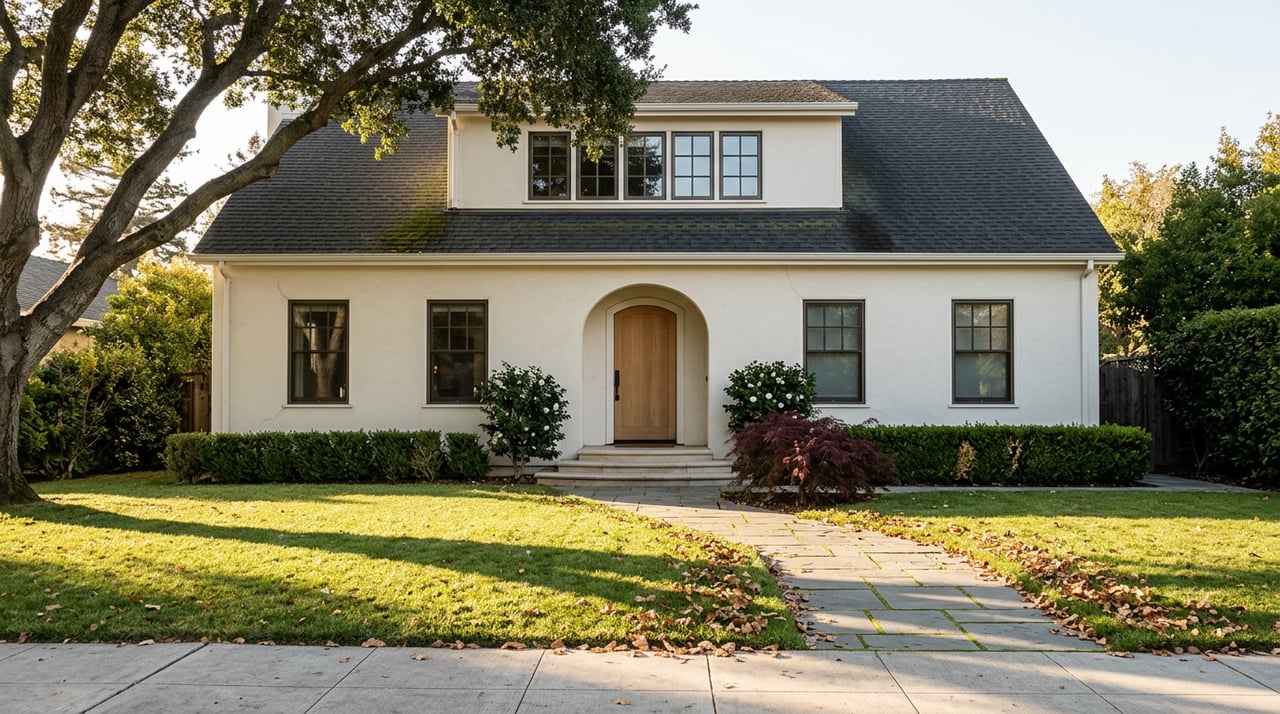
Burlingame Park vs. Easton Addition: Why the More Restricted Neighborhood Costs More
If you're cross-shopping Burlingame Park and Easton Addition, you'll eventually run into a number that doesn't add up. Burlingame Park won't let you tear down a house without a historic review first. Easton Addition will, as long as you follow the city's standard design guidelines. So why does the neighborhood with fewer building rights carry the higher price tag on raw land?
Most buyers assume the opposite is true. More flexibility to build should mean more value, since a buyer is paying for both the house and the option to replace it later. That assumption breaks down the moment you look at what these two lots actually sell for.
A 6,000 square foot teardown lot in Easton Addition recently sold for $2.85 million, a record for the neighborhood. That's the best price a bare, rebuild-ready parcel has ever fetched there.
In Burlingame Park, that same size of raw land is hard to find for under $3 million on an ordinary day. Not a record. A floor.
Read that again: Easton Addition's ceiling sits below Burlingame Park's baseline. The neighborhood where you need a historic determination before you can touch the structure is pricing its dirt higher than the neighborhood where teardown and rebuild is the norm.
Part of this comes down to size. Burlingame Park's typical lot runs closer to 7,500 square feet, against roughly 6,000 in Easton Addition, so buyers are paying for more land to begin with. But a 25 percent larger lot doesn't fully explain a floor that beats a record. Something else is doing the work.
Burlingame Park's rule is the one that should make land cheaper. Instead it has the priciest floor in the city.
The other half of the answer is inventory, and it isn't close.
| Easton Addition | Burlingame Park | |
|---|---|---|
| Homes in the neighborhood | 1,555 | 451 |
| Share of Burlingame's roughly 6,200 houses | About 25% | A small fraction |
| Share of annual Burlingame home sales | About 25% | Roughly a third of Easton's sale count |
| Typical lot size | About 6,000 sq. ft. | About 7,500 sq. ft. |
| Rebuild process | Standard city design review | Historic determination required |
Easton Addition is Burlingame's most liquid neighborhood. With that much of the city's total housing stock sitting inside its boundaries, a buyer has real choices in any given season, and sellers know it. Burlingame Park works the opposite way. With well under 500 homes total and a fraction of Easton's annual sales, a single transaction can set the tone for the whole neighborhood for months. Scarcity, not buildability, is setting the price.
There's also a walk-score gap underneath the paradox. Burlingame Park sits closer to Burlingame Avenue's shops and restaurants, while Easton Addition's southern blocks lean toward Broadway and its northern edge toward Burlingame Plaza for everyday errands. Both are walkable. Only one is a short walk from the city's main retail spine, and that proximity appears to be priced in ahead of construction flexibility.
Here's what the historic designation actually requires. Before an owner in Burlingame Park can demolish a structure, the city determines whether the home qualifies as historic. If it does, the owner generally has to preserve the facade and how the house presents to the street, even if the interior gets fully rebuilt. In most of the rest of Burlingame, including Easton Addition, an owner can buy a lot, tear down the existing structure, and build new, subject to the same architectural and design review every Burlingame project goes through.
On paper, that's a real constraint. It limits who can buy in Burlingame Park with rebuild plans and narrows what a buyer can do with an older structure. And yet the land under those restricted homes is worth more, not less, than land a few blocks away where no such review exists.
That's the actual lesson here. Development rights are one input into land value, not the whole formula. When a neighborhood has 451 homes and a fraction of the annual turnover of its neighbor, scarcity can outweigh what you're legally allowed to build.
None of this means Easton Addition is the value play. Through the first half of 2026, the neighborhood's average sale price climbed 9.2 percent year over year to $3.954 million, up from $3.621 million in 2025. The median rose even faster, up 9.4 percent to $4.025 million from $3.679 million. Homes are also selling more competitively than they were a year ago, with the sale-to-list ratio strengthening to 105.7 percent from 103.4 percent.
One number moved in the opposite direction. Price per square foot came in at $1,506 for the first half of 2026, down slightly from $1,527 in 2025. Total prices rose while the per-square-foot figure slipped, and that combination points to what's actually happening on the ground: older two-bedroom homes are being replaced with larger new construction, frequently in the 3,000 square foot range, and those new builds are pulling the neighborhood's total price up even as they hold or slightly soften the per-foot number. New construction in Easton Addition typically lands around $5 million.
That's the rebuild engine Burlingame Park's historic review makes harder to run. Easton Addition owners are converting lot value into house value through teardown and rebuild at real volume, several dozen sales close there most years. Burlingame Park owners can't do that as freely, and their land is pricier anyway.
The paradox resolves once you ask what you're actually buying.
Whichever direction you lean, treat comps carefully. A Burlingame Park sale and an Easton Addition sale are not interchangeable data points, even when the closing prices land close together. Match lot size, match property type, and keep the sales window tight, ideally the last 30 to 90 days in a market moving this fast.
Can I tear down a home in Burlingame Park? Only after the city determines whether it qualifies as historic. If it does, you'll generally need to preserve the facade and its presentation to the street, even in a full renovation.
Is Easton Addition's rebuild market actually active, or is that theoretical? It's active. Several dozen sales close in the neighborhood most years, roughly three times Burlingame Park's annual volume, and new construction sales are running around $5 million.
Which neighborhood is the safer long-term hold? Both function as anchors for Burlingame's high end. The honest answer depends on what you're buying: flexible, rebuildable land with strong liquidity, or a fixed slice of a market that rarely turns over at all.
If you're weighing Burlingame Park against Easton Addition, or trying to figure out where your budget actually lands once you account for lot size and rebuild rights, the Wang Tang Group works these blocks regularly and can walk you through the comps that matter for your specific plan. Request a free home valuation and we'll show you exactly what your money buys in either direction.

Jenny and Carmen live with their families in the Peninsula and are trusted by hundreds of clients, having successfully closed countless transactions across San Mateo, San Francisco, Santa Clara, and Alameda counties. From property upgrades, inspections, and strategic marketing to finding the best lenders, they guide clients through every step of the real estate journey.

Wang Tang Group
Address
1440 CHAPIN AVE STE 200
BURLINGAME, CA 94010
Jenny Wang | CA DRE# 02063767
Carmen Tang | CA DRE# 01974969